
Emergency Triage

In the emergency department, triage nurses must decide quickly who needs care first, often amid noise and constant interruptions.

The Emergency Triage project developed a serious game that reproduces the emergency department, in order to study how distractors such as noise and task interruptions affect the quality of nurses’ triage decisions.

Supported by the HES-SO, with the Institut et Haute Ecole de la Santé La Source and the Geneva University Hospitals (HUG).

Key information

Project at a glance

Focus
Emergency triageEnvironmental distractorsRandomised controlled trial
Period
2018–2019
Funding
HES-SO University of Applied Sciences and Arts Western Switzerland
Partners
Institut et Haute Ecole de la Santé La Source
Geneva University Hospitals (HUG)
AlbaSim, HEIG-VD, HES-SO

Overview

Studying triage decisions in a realistic but controlled environment

Triage determines how quickly each patient is seen. A wrong priority can delay care for a critically ill patient or overload the department.

The gap

Noise, phone calls and interruptions are part of everyday work in the emergency department, but their effect on triage accuracy is hard to measure in real conditions, where every situation is different and patients cannot be put at risk.

Project objectives

The project brought together nursing, emergency medicine and engineering around one aim:

  1. Simulate: develop a serious game that reproduces a working environment containing sources of distraction.
  2. Measure: use the game to study the impact of these distractors on the quality of triage in emergency departments.
IN THE EMERGENCY DEPARTMENTTriage under pressureDISTRACTORSNoise and alarmsTask interruptionsTHE PROJECTA simulated emergency department1Realistic triage cases2Controlled distractors3Randomised controlled trialsGOALMeasure the impact on triage accuracy

Outcomes

A serious game for clinical research

  • A simulated emergency department

    A serious game reproducing the emergency department, in which nurses triage patients while exposed to noise and task interruptions.

  • A tool for randomised trials

    The study showed that the serious game can be used to carry out randomised controlled trials (RCTs) on triage decisions.

  • New research questions

    No distractor effect was found, which raises questions about the frequency and intensity of distraction needed to affect triage performance.

From research to practice

From a first prototype to a published trial

In 2019, a panel of triage experts evaluated the usability and realism of the game, developed with La Source. The game was then used in a pilot randomised controlled trial with 70 emergency nurses.

A study carried out with the game received the Silver U Award at the French Society of Emergency Medicine conference in 2021, and the results were published in International Emergency Nursing in 2024.
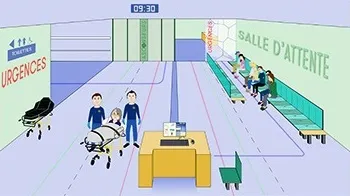

A panel of triage experts testing the Emergency Triage game

Key finding

What our research shows

  • Within the serious game, noise and task interruptions had no measurable effect on emergency nurses’ triage accuracy, which raises questions about the intensity of distraction needed to affect clinical decisions.

    Pilot 2 × 2 factorial RCT, 70 emergency nurses · Fiorentino et al., International Emergency Nursing, 2024

    Read the paper(opens in a new tab)

Partners

A collaboration between nursing, emergency medicine and engineering

The project was carried out by the Institut et Haute Ecole de la Santé La Source, the Geneva University Hospitals (HUG) and the AlbaSim team of the Media Engineering Institute (MEI) at HEIG-VD (HES-SO), led by Prof. Dominique Jaccard.

Nurses, emergency physicians, researchers and developers worked together on the triage cases, the simulated environment and the study design.

Acknowledgements

We thank the HES-SO for supporting this project.

Resources

Everything you need to dive deeper into the project

Collaborate with us

Interested in a research collaboration? We would be glad to discuss joint projects.